Thursday, April 29, 2010

MGMT


A song on MGMT's newest album is called "Brian Eno", and, well, it's all about him. The only reason I know who Brian Eno is is because of EMAC.. So I thought it was blog appropriate to exploit my enthusiasm of hearing it. Woo!

Saturday, April 24, 2010

Illegal Remixing?

The controversy that revolves around copyright infringement and music is a tricky one. I personally love Girl Talk and think that “his” music is both a lot of fun, audibly enjoyable and shows incredible talent. I don’t believe that his usage of other artist’s music in his own work is wrong, as he is only using portions of different artists’ songs and putting them together in ways that do not sound anything like the original, and is more representational of his own style. The main reason that people get so upset over the whole ordeal is because of money: people aren’t profiting from Girl Talk’s work, and therefore are not okay with it. It seems that they don’t care so much about it being like “stealing” someone else’s art, which is not fair. I also don’t think it’s fair to stop people like Girl Talk from creating music because of copyright laws. Artists should definitely have the right to make something new from something old, especially if it’s creating something completely new that sounds totally different. And hey, look at Duchamp. I don’t think the makers of his read-mades were ever given credit.

If someone wished to use my work and integrate it into their work, I would first be more than honored that someone likes my work enough to use it in theirs, and I would second be more than okay with it, as long as I am given credit. If someone used my work and claimed it as their own, I would of course not be okay with that, however I'm sure that would not be the case.
The idea of "intellectual property" is a little ridiculous, as I'm sure two people have shared the same thought. Owning a thought, and having legal rights to that thought seems kind of illogical and halts the production of more ideas.

Wednesday, April 21, 2010


I used to listen to Kraftwerk when I was young, never realizing how important they were in music history for the development of music. I was attracted to the strangeness of it, and how different it was than anything else at the time (as far as the musical interests of middle schoolers goes). Watching the Synth Britannia documentary opened up my eyes a little bit more, when it comes to understanding the evolution of music from instrumental to electronic and so on. Synthetic music is integrated in a good majority of modern music, so after watching that video I have made many connections with how certain sounds are made in certain songs. Many contemporary artists revolve around the whole idea of electronic music and synthetic sounds. Take the Crystal Castles that my roommate is playing right now - they're into the whole cheap 16-bit sound, integrating strange screechy synth sounds (sweet alliteration, right?). I always find this type of modern electronic music to be fun although mildly annoying at times, and definitely a step up from the 80's version of new electronic.

Wednesday, March 31, 2010

Privacy is a made up term.

There is absolutely no such thing as privacy anymore, in our section of the world at least. It's really pathetic that it has come to this point, but it has. Pieces of information are constantly being collected about you, if you chose the route which is deemed as correct, as in getting an education, a job, a house, a family, a social life, etc. The only way that one would achieve ultimate privacy would be to have no contact with anyone, burn their records, and live in a remote area. [Probably my favorite movie,] this happens in "Into the Wild", which is based on a true story of a man by the name of Christopher McCandless who, upon graduating college, burns his money, social security card and other records, leaves his family and any contacts, and sets out to live in the wild to experience solitude from isolation and complete privacy. It is beautiful yet sad that he had to go through all that to get to that point. Anyway, my point is that privacy cannot be achieved easily, if at all. Even when it came to applying to school and scholarships, the forms seriously asked for every bit of information about me- from the year that my car was made to how many credits my sister took last semester. It's a little ridiculous.

PS: If your name doesn't begin with a 'J' and end with an 'asonSloan', than you may or may not be invading my blog privacy right now..

Tuesday, March 30, 2010

Hacking: The Ultimate Hobby

I used to think of hacking as something negative, as something you do to invade someone else's personal belongings. Back in the days of when MySpace was still popular (ha), it seemed like quite a common and exciting thing for others to hack into other people's profiles. Reading their messages, rewriting their information. Lame, but that's what I first think of. That or hacking into someone's email account, other other type of account which can be of great importance. I never thought of hacking as something positive and helpful to the technological world. I have absolutely zero knowledge of how anything works under the hood of a computer, phone, etc., so hearing about how others get into these systems and manipulate them to their liking is so impressive to me. The video that we watched in class was all about manipulating the phone system so they did not have to pay for calls, which led to inspire some bright people who founded Apple and started the whole Mac generation. I admire their intelligence in technological systems, and find it so inspiring how they did everything their way and paid attention to no rules. Steve Wozniak spoke about how he did not want to follow the way other systems worked, and wanted to create his own versions of what was already out there. This is such a great idea to follow as an artist, as it is so important to be ahead of the game and being the one to not simply follow other artists, but help the advancement of the art world in having an entirely new approach in it all.
Thank the world for geeks. And those who are constantly thinking forward.

Thursday, March 4, 2010

Wednesday, February 24, 2010

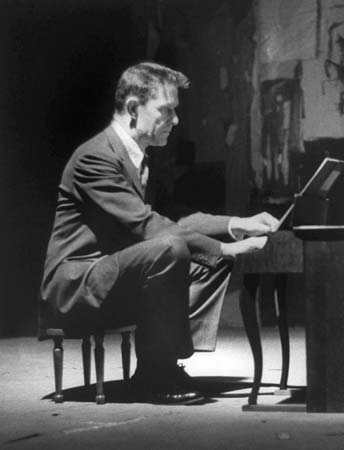
John Cage

The "music" that John Cage claims to create seems to fit in with any other art that is extremely controversial at the time. He creates scores on the basis that harmony is not important, which does not follow traditional ways of writing music. He has "little feeling for harmony", even though it is predetermined as one of the basic elements of music. His music does not necessarily make sense to me, nor do I enjoy it as real art as it takes no real skill, however I believe that his ideas are important as with any other ideas that protest against traditional ways.

When Cage is asked how he feels about his work being viewed as comical, he responds that he does not mean to be funny, however, "if something funny happened, it would be acceptable... better laughter than tears." His response is pretty great, as I find his work to be mildly funny. His notorious piece "4:33" in which he merely sits on a chair in front of a piano and does nothing, is funny in the sense that it takes no real skill, work, or seriousness. The only possible thing that I can appreciate about this piece is that it is ambient in a way, as it forces the audience to listen to silence which, naturally, brings relaxation. It allows the audience to listen to sounds all around them that would otherwise go unnoticed or unappreciated, not that random coughs or chairs creaking need to be appreciated.